
World Teachers’ Day 2026 marks 60 years since the ILO/UNESCO Recommendation concerning the Status of Teachers. Its theme, ‘Standing with teachers: 60 years of protecting the profession, advancing its status and shaping our futures’, is especially relevant for teachers working with refugees and other forcibly displaced learners, where access to continuous professional learning can be limited.
The anniversary comes at a moment when teachers are adapting to profound changes in education, from growing demands for inclusion and education in emergencies to the rapid expansion of digital technologies and artificial intelligence (AI).
As digital technology and artificial intelligence reshape education, teachers need access to tools, as well as the knowledge, confidence and professional judgement to decide how, when and why technology should be used.
To achieve this, we need to invest in practical, sustained learning that reflects the realities of their classrooms.
Teaching for Life: a structured professional development programme from technology to teaching
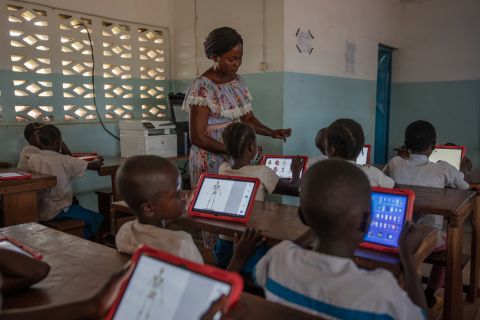
Instant Network Schools (INS) connects refugees, host communities and their teachers with digital learning content and the internet, improving the quality of digital education in communities that have been marginalised in Africa. The programme is delivered through a partnership between Vodafone Foundation and UNHCR, the UN Refugee Agency.
Teaching for Life was developed through the programme to support teachers to strengthen learner-centred pedagogies, life-skills education and the integration of INS technology into classroom practice. Its three progressive levels - Beginner, Intermediate and Advanced - are designed to support development and have been shaped over time by teachers’ feedback and different classroom contexts.
An increase in confidence and professional competence
An evaluation led by Dr Emily Setty at the University of Surrey followed INS teachers in South Sudan, Kenya and the Democratic Republic of the Congo before and after Beginner-level training, and after they returned to school.
What emerges is a story not simply about training, but about professional growth that matters.
The findings show clear progress. Correct responses to 13 questions on learner-centred teaching rose from 57% before training to 81% afterwards. At follow-up, 87% of teachers reported feeling more, or a little more, confident as facilitators of learning, while 98% reported some improvement in their professional competence.
Teachers described moving from being the main source of knowledge to facilitating discussion, participation and collaboration. There is evidence of continued use of the approaches after training and adaptation to different subjects, class sizes, resources and classroom conditions. When technology or infrastructure was unavailable, some turned technology-based activities into group discussions and other participatory exercises.
As one Kenyan teacher explained:
“Before the training, [teaching was mainly]… teacher-centred. But after the training… every learner is now active and every learner is involved [in the learning process].”
This shift is important because professional development is about learning new techniques, and then developing the confidence and professional judgement to apply them in different contexts.
Teachers also reported greater learner engagement, collaboration and confidence, although the evaluation captured teachers’ perceptions rather than independently assessed student outcomes. Learning also travelled beyond those trained: 95% said they had shared Teaching for Life approaches with other educators.
Standing with teachers means sustained support
Training alone cannot transform teaching. The evaluation is equally clear about the barriers teachers face, including large classes, limited time and space, insufficient resources, infrastructure constraints and diverse learning needs. Teachers also need continued professional learning, practical resources, peer support and classroom conditions that help them put learning into practice.
The wider lesson is simple. Teachers in crisis and displacement settings are experienced professionals with knowledge and agency. Effective professional learning builds on those strengths and helps teachers adapt evidence-informed approaches to their own context and create opportunities for learning to spread through peer networks.
As technology changes education, strengthening teachers is one of the most important ways we can strengthen quality education for all, including refugees and forcibly displaced learners.
Image credit: UNHCR/Guerchom Ndebo
More stories